
The real reason Calgary skin falls apart every November, and your two-week plan to get ahead of it
Let's play a quick game. Think back to last year. Early October? Your skin was probably fine. Maybe even glowing. Then somewhere around mid-November, things went sideways. Tight after cleansing. Flaky around the nose. Makeup sitting on dry patches. That serum you love suddenly stinging. Maybe some redness you can't explain.
And every year you think, "Ugh, it's the cold."
Here's the twist: it's mostly not the cold outside. It's what happens inside, in one very specific week. On Sunday, November 1st, the clocks fall back. That same stretch is when nights stay below freezing for good and the furnace goes from "sometimes" to "all the time." That combination, not the first snowfall, is what really sets off Calgary winter skin.
If you go through the same thing every single winter and never understood why, grab a tea. This one's for you.
Your living room is drier than the Sahara (really)
Here's a bit of simple science that changes everything. Cold air can't hold much water. So when your furnace pulls in freezing outdoor air and warms it up, the amount of water in that air stays the same, but the air now could hold much more. That means the humidity drops like a stone.
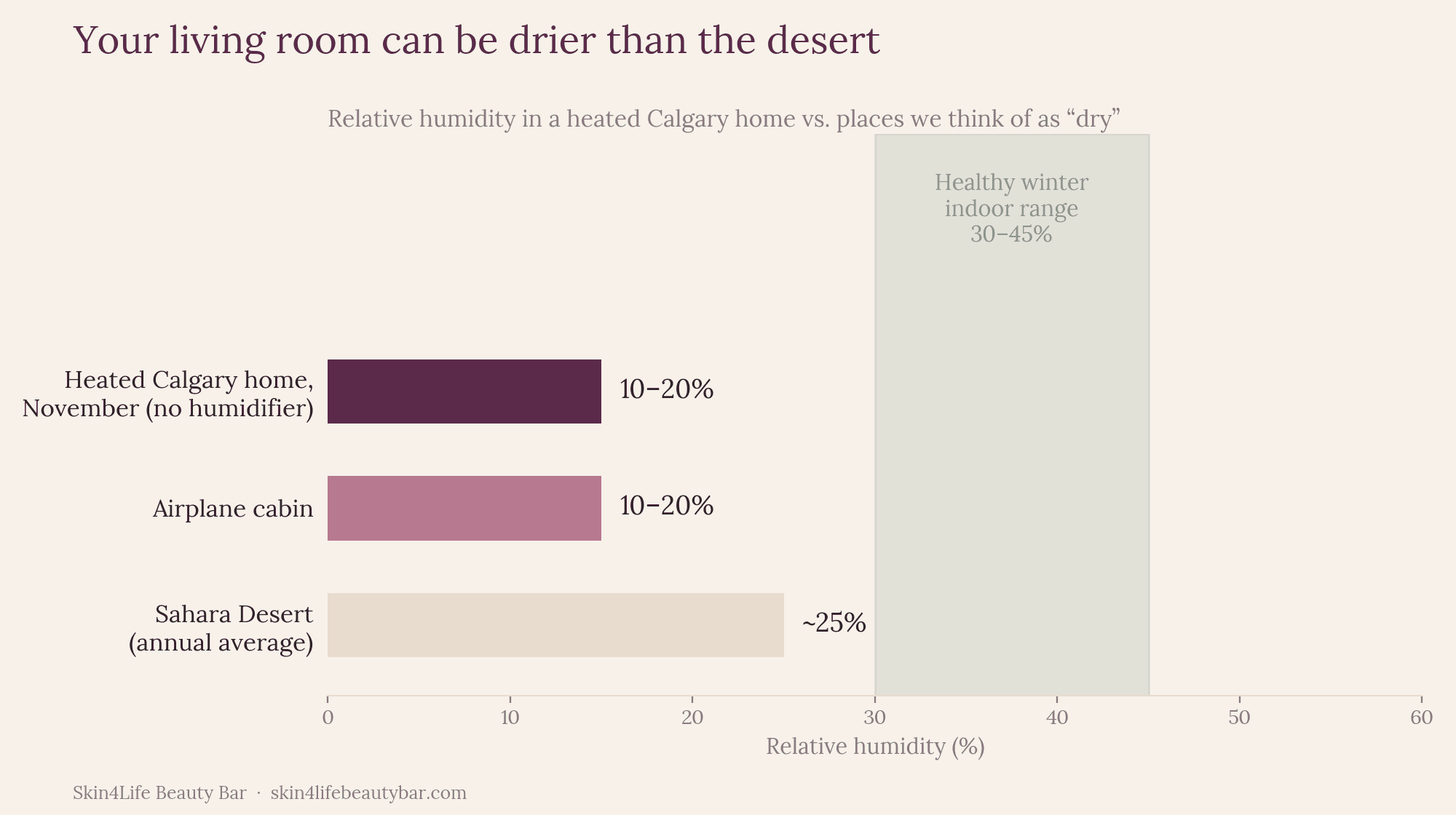
A real Calgary example: on a −10°C night, outdoor air might sit at a comfy-sounding 70% humidity. Warm that same air to 21°C in your home and it drops to roughly 7–8% humidity. Cooking, showers and breathing add a bit of moisture back, but many heated Calgary homes still sit around 10–20% without a humidifier.
For perspective, the Sahara Desert averages about 25%. An airplane cabin, the place everyone complains makes their skin feel like paper, sits around 10–20%. So on a November night, your bedroom can be closer to an airplane than to a desert. For comparison, housing experts in Canada usually recommend keeping winter indoor humidity around 30–45% (a little lower during deep cold snaps so your windows don't fog and frost).
Your skin is constantly trading water with the air around it. When the air is this dry, it pulls water out of the top layer of your skin all day and all night, including the eight hours you're asleep.
It's not the dry air. It's the sudden drop.
This is the part most people have never heard, and it explains a lot.
Your skin is actually pretty smart. Give it time and it can adapt to dry air by building a tougher barrier. The problem is speed. In lab research published in the Journal of Investigative Dermatology, skin that had been living in humid conditions developed clear barrier problems when the humidity dropped suddenly. It simply didn't have time to adjust (Sato et al., 2002).
A related study found that low humidity makes skin cells multiply faster and overreact when the barrier gets damaged. The researchers linked this directly to why conditions like eczema and psoriasis flare up in winter (Denda et al., 1998).
Think of it like jumping into a cold lake versus walking in slowly. Same water, very different shock. For your skin, the week the furnace switches on full-time is the jump.
Why this matters in Calgary especially
We have chinooks. Temperatures can swing 15–20°C or more in a few hours, and humidity swings with them. If sudden change is what stresses the barrier, then every chinook gives your skin a small shock, all winter long.
We're up high. Calgary sits at about 1,045 m. UV gets roughly 10% stronger with every 1,000 m of altitude, and fresh snow can bounce back up to 80% of UV rays (WHO). Winter SPF is not optional here.
Our tap water gets harder in winter. The City of Calgary reports that hardness peaks between December and February. Hard water is linked to more soap residue on the skin and more irritation (Danby et al., 2018). Pair that with the long, hot showers we all crave in November, and your barrier takes another hit.
Why your skin looks fine in October and miserable in mid-November
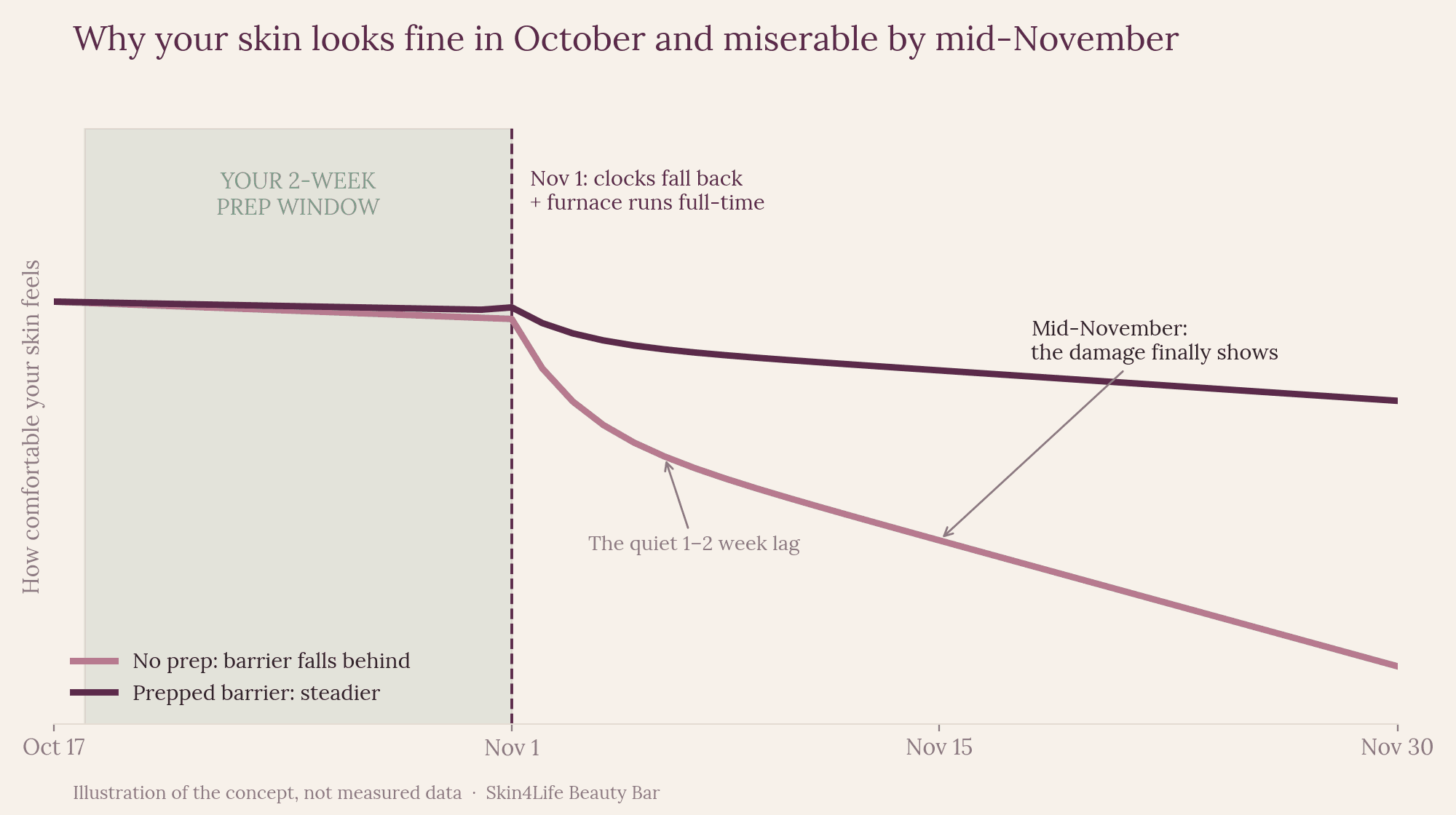
If the furnace kicks in on November 1st, why doesn't your skin freak out on November 2nd? Because of a lag, and it's the key to this whole article.
1. Your skin needs water to shed properly
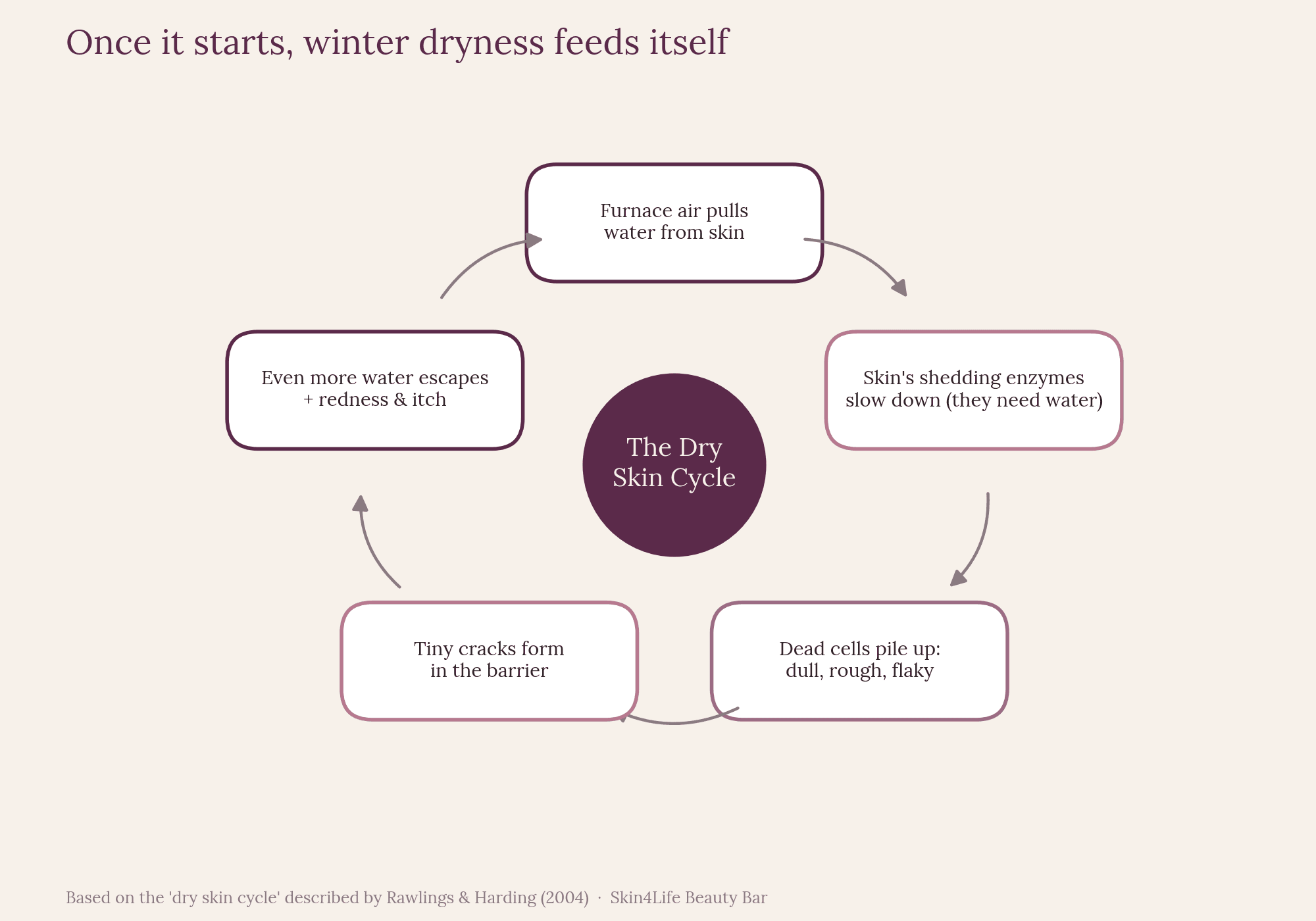
The top layer of your skin is made of flattened cells held together like bricks and mortar. To shed old cells, your skin uses tiny enzymes that act like little scissors. Here's the catch: those scissors need water to work. When the air dries your skin out, they slow down. Old cells stop shedding evenly and start piling up. That's the dull, rough, "my foundation looks cakey" feeling.
2. Piled-up cells crack, and cracks leak
That pile-up doesn't bend well. It develops microscopic cracks. Cracks let even more water escape, which dries the skin further, which slows the enzymes further. Skin scientists call this the dry skin cycle (Rawlings & Harding, 2004). It builds quietly for a week or two before you really see it. Hello, mid-November.
3. Your barrier makes less of its own "mortar" in winter
The mortar between your skin cells is made of fats called ceramides, cholesterol and fatty acids. Studies have found that ceramide levels in the skin's outer layer are lower in winter than in summer, including a key ceramide that holds the whole structure together (Rogers et al., 1996; Conti et al., 1996). So in winter your skin is losing more water and has fewer building blocks to fix the damage.
4. Cold turns down your oil
This one surprises even oily-skin clients. Research found that sebum (your skin's natural oil) output changes by about 10% for every 1°C change in skin temperature (Cunliffe et al., 1970). Chilly cheeks on the walk to the car make less protective oil. It's why your summer foaming cleanser suddenly feels harsh, even if you're normally shiny by noon.
So what do the clocks have to do with any of this?
More than you'd think. Your skin runs on its own 24-hour clock, just like your sleep. Research shows skin loses the most water in the evening, and skin cells do most of their dividing and repair work at night (Matsui et al., 2016). Night is when your skin rebuilds.
When the clocks shift, that inner clock falls out of step with your day for a while. And the time change arrives at exactly the moment your skin needs its best repair.
Sleep matters here too. In a study from University Hospitals Case Medical Center in Cleveland, women who slept well recovered from skin barrier damage about 30% better than poor sleepers, and showed fewer signs of skin aging (Oyetakin-White et al., 2015).
“Our study is the first to conclusively demonstrate that inadequate sleep is correlated with reduced skin health and accelerates skin aging.”
— Dr. Elma Baron, dermatologist and Director of the Skin Study Center, UH Case Medical Center
Then there's real life. After November 1st, a lot of us wake up in the dark and get home in the dark. The evening routine gets rushed or skipped. ("I'll just wash my face tomorrow." We've all been there.) That's the opposite of what skin needs when night is its prime repair time.
One more thing about light: a classic study found that in Edmonton, winter sunlight is too weak for your skin to make vitamin D from roughly October to March (Webb et al., 1988). Calgary sits at almost the same latitude. Vitamin D plays a role in how skin cells mature and defend themselves. We're estheticians, not doctors, so if you're curious about your levels, that's a great question for your physician.
Your two-week game plan: start around October 18
The good news? Because there's a lag, you have a head start. The two weeks before November 1st are your window to build the barrier up before the furnace tears it down. Here's what we'd tell a client in the treatment chair.
Week 1 (October 18–24): calm things down
- Swap your cleanser. Move from foaming to a gentle cream, milk or gel cleanser. Squeaky clean = stripped barrier.
- Ease up on actives. If you use retinol or exfoliating acids, drop to every second or third night for now. We're not quitting them, just giving your skin some room.
- Get a hygrometer. It's a tiny $15 gadget that shows your home's humidity. Most people are shocked the first time they check. Aim for 30–45%.
- Turn the shower down a notch. Warm, not hot, and keep it short. Pat dry and apply moisturizer while skin is still a little damp.
Week 2 (October 25–31): build and seal
- Switch to a real barrier cream. Look for ceramides, cholesterol and fatty acids together. Research on barrier repair found these three work best as a team, in roughly a 3:1:1 balance. Using just one on its own can actually slow repair down (Man et al., 1996). A cream that just says "ceramide" on the front isn't the same thing.
- Seal at night. A thin layer of an occlusive balm over your moisturizer, especially on cheeks and around the nose. Petrolatum-based occlusives can cut water loss from the skin by over 98% (Sethi et al., 2016). A little goes a long way.
- Run a humidifier in your bedroom. Put it where you sleep, because that's where your skin does its repair work. Clean it often.
- Protect your sleep through the time change. Keep a steady bedtime the week of November 1st. Your skin's night shift depends on it.
- Keep your SPF. Altitude plus snow means UV is still very real, even when it's −15°C.
- Book a barrier-focused facial before November 1st. This is the professional reset: we hydrate deeply, gently clear the build-up, and set your skin up for the season, before the damage starts.
“Your skin provides the body's first line of defense against allergens, irritants, and infections.”
— Dr. Alexandra Coromilas, dermatologist and Assistant Professor of Dermatology, Columbia University Irving Medical Center
That's why we care so much about the barrier. When it's healthy, everything else (glow, calm, even how well your serums work) falls into place.
New at Skin4Life: HISTOLAB, made for skin recovery
We've been looking for a long time for a line that matches the way we think about skin: repair first, then glow. We found it, and we're so excited to finally share it with you.
HISTOLAB is a Korean medical skincare line used in more than 10,000 dermatology and aesthetic clinics around the world. It was built for one of the hardest jobs in skincare: helping skin recover and rebuild its barrier, even after professional treatments like peels and microneedling. At its heart is the brand's patented SRGF H1 Complex, a blend of peptides and growth-factor ingredients designed to calm stressed skin and support its natural repair.
In plain words: it's made for skin that's been through something. And a Calgary November absolutely counts.
Products like the HISTO Cell Cream are designed for compromised, sensitive barriers. It's exactly what we reach for when a client comes in tight, red and flaky, and exactly what we'd want on your skin before the furnace season hits. It's the most barrier-focused recovery line we've ever carried.
A little heads-up: our first HISTOLAB batch is small
HISTOLAB arrives at Skin4Life this month, and our first shipment is limited. We're taking pre-orders now so you can have your barrier routine ready for your two-week prep window.
Not sure which products your skin needs? Book a consultation or facial and we'll build your HISTOLAB routine with you, based on your skin, not a guess.
The bottom line
Your skin doesn't fall apart in November because you're doing something wrong. It happens because, in one week, the air in your home becomes drier than a desert, your body clock gets knocked off, your skin makes less oil and less of its own "mortar," and a quiet cycle starts that doesn't show up until mid-month.
Now you know the pattern, and that means you can get ahead of it. Two weeks of prep is all it takes to walk into winter with skin that's calm, comfortable and glowing, instead of tight and flaky.
At Skin4Life, we believe beauty forms from within. That means strong skin, a calm nervous system, and a plan that works with your body instead of against it.
Ready to get ahead of winter this year?
Book your pre-winter barrier facial before November 1st at skin4lifebeautybar.com, and ask us about pre-ordering HISTOLAB so your home routine is ready when the furnace kicks in.
Your October self will thank you. Your November self will thank you even more.
Book your consultation
Book at Skin4LifeCurious about skincare science, at-home and in-clinic treatments, and decoding the latest trends? Follow along on Instagram @skin4life_beautybar.
References & Citations
- Conti, A., Rogers, J., Verdejo, P., Harding, C. R., & Rawlings, A. V. (1996). Seasonal influences on stratum corneum ceramide 1 fatty acids and the influence of topical essential fatty acids. International Journal of Cosmetic Science, 18(1), 1–12.
- Coromilas, A. (n.d.). A dermatologist's guide to healthy winter skin. Columbia University Irving Medical Center. https://www.cuimc.columbia.edu/news/dermatologists-guide-healthy-winter-skin
- Cunliffe, W. J., Burton, J. L., & Shuster, S. (1970). The effect of local temperature variations on the sebum excretion rate. British Journal of Dermatology, 83(6), 650–654.
- Danby, S. G., Brown, K., Wigley, A. M., et al. (2018). The effect of water hardness on surfactant deposition after washing and subsequent skin irritation in atopic dermatitis. British Journal of Dermatology, 178(5), 1183–1190.
- Denda, M., Sato, J., Tsuchiya, T., Elias, P. M., & Feingold, K. R. (1998). Low humidity stimulates epidermal DNA synthesis and amplifies the hyperproliferative response to barrier disruption: Implication for seasonal exacerbations of inflammatory dermatoses. Journal of Investigative Dermatology, 111(5), 873–878.
- Engebretsen, K. A., Johansen, J. D., Kezic, S., Linneberg, A., & Thyssen, J. P. (2016). The effect of environmental humidity and temperature on skin barrier function and dermatitis. Journal of the European Academy of Dermatology and Venereology, 30(2), 223–249.
- Man, M. Q., Feingold, K. R., Thornfeldt, C. R., & Elias, P. M. (1996). Optimization of physiological lipid mixtures for barrier repair. Journal of Investigative Dermatology, 106(5), 1096–1101.
- Matsui, M. S., Pelle, E., Dong, K., & Pernodet, N. (2016). Biological rhythms in the skin. International Journal of Molecular Sciences, 17(6), 801.
- Oyetakin-White, P., Suggs, A., Koo, B., Matsui, M. S., Yarosh, D., Cooper, K. D., & Baron, E. D. (2015). Does poor sleep quality affect skin ageing? Clinical and Experimental Dermatology, 40(1), 17–22.
- Rawlings, A. V., & Harding, C. R. (2004). Moisturization and skin barrier function. Dermatologic Therapy, 17(Suppl. 1), 43–48.
- Rogers, J., Harding, C., Mayo, A., Banks, J., & Rawlings, A. (1996). Stratum corneum lipids: The effect of ageing and the seasons. Archives of Dermatological Research, 288(12), 765–770.
- Sato, J., Denda, M., Chang, S., Elias, P. M., & Feingold, K. R. (2002). Abrupt decreases in environmental humidity induce abnormalities in permeability barrier homeostasis. Journal of Investigative Dermatology, 119(4), 900–904.
- Sethi, A., Kaur, T., Malhotra, S. K., & Gambhir, M. L. (2016). Moisturizers: The slippery road. Indian Journal of Dermatology, 61(3), 279–287.
- University Hospitals Case Medical Center. (2013, July 23). Sleep deprivation linked to aging skin, study suggests. ScienceDaily. https://www.sciencedaily.com/releases/2013/07/130723155002.htm
- Webb, A. R., Kline, L., & Holick, M. F. (1988). Influence of season and latitude on the cutaneous synthesis of vitamin D3. Journal of Clinical Endocrinology & Metabolism, 67(2), 373–378.
- World Health Organization. (2002). Global Solar UV Index: A practical guide. WHO.
- City of Calgary. (n.d.). Water quality, water hardness and water data. https://www.calgary.ca/water/drinking-water/water-quality-water-hardness-water-data.html
- CAA-Québec. (n.d.). Temperature and humidity variations: Ideal humidity levels in a home. https://www.caaquebec.com/en/advices/maintaining-a-home/guides/your-healthy-home-guide/temperature-and-humidity-variations
- The Canadian Encyclopedia. (n.d.). Chinook. https://thecanadianencyclopedia.ca/en/article/chinook
- HISTOLAB Canada. (n.d.). No.1 Korean medical skincare. https://histolab.ca/
This content is for educational purposes and does not constitute medical advice.